English
  한국어
한국어

A circuit breaker is a critical component in any electrical system, providing overcurrent and short-circuit protection. Among the various types available, hydraulic circuit breakers—also known as hydraulic-magnetic circuit breakers—offer unique advantages for DC applications. This guide explains how hydraulic circuit breakers work, what to consider when selecting one, and where they are commonly used.
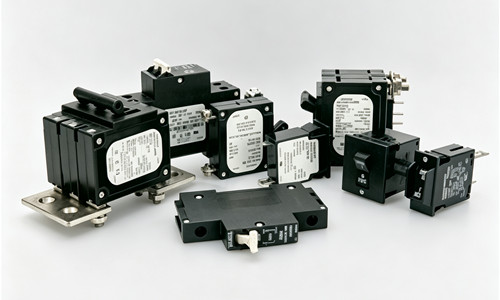
What Is a Hydraulic Circuit Breaker?
A hydraulic circuit breaker is a protective device that uses a solenoid and a viscous fluid to control the tripping mechanism. Unlike thermal circuit breakers, which rely on a bimetallic strip that heats up under overcurrent, hydraulic breakers respond to current magnitude and duration with high precision and are largely immune to ambient temperature variations.
Key characteristics:
- Temperature-stable tripping — unaffected by ambient temperature changes
- Precise current response — accurate trip timing based on current level
- Reliable DC interruption — well-suited for DC circuits where arc extinction is challenging
- Long service life — minimal wear due to hydraulic damping
How Does a Hydraulic Circuit Breaker Work?
The core of a hydraulic circuit breaker consists of:
- A solenoid coil in series with the load current
- A magnetic core that moves through a silicone fluid-filled tube
- A spring that holds the contacts closed under normal conditions
- A trip mechanism that releases the contacts when the core reaches its travel limit
Under normal current, the magnetic force is insufficient to move the core against the spring tension. Under overcurrent, the increased magnetic force pulls the core through the fluid. The time delay is controlled by the viscosity of the fluid and the spring tension—higher currents move the core faster, resulting in faster tripping.
Time-Current Characteristics
Hydraulic breakers offer inverse time delay: the higher the current, the faster the trip. This matches the thermal characteristics of most loads and wiring, providing coordinated protection.
| Overcurrent Level | Typical Trip Time |
|---|---|
| 100% of rating | No trip (continuous) |
| 125% of rating | 10-60 seconds |
| 200% of rating | 2-10 seconds |
| 400% of rating | 0.2-1.0 second |
| 1000% of rating | < 0.1 second (instantaneous) |
Hydraulic Circuit Breaker vs. Thermal Circuit Breaker
| Feature | Hydraulic Breaker | Thermal Breaker |
|---|---|---|
| Temperature stability | Excellent (trip point stable) | Poor (trip point shifts with temperature) |
| DC performance | Excellent | Fair (heating unaffected by DC/AC) |
| Trip accuracy | High (±10%) | Moderate (±20%) |
| Reusability | Many operations | Limited by thermal fatigue |
| Cost | Higher | Lower |
| Best application | Precision DC protection | AC general-purpose protection |
For DC applications, hydraulic breakers are generally preferred because they provide consistent protection regardless of ambient temperature.
Key Selection Parameters
1. Rated Current
Select a breaker with a current rating that matches your load. The rating should be:
- At least 15-20% above the normal continuous load current
- Below the maximum current rating of your wiring and connectors
For example, a circuit with 80A continuous load should use a 100A breaker.
2. Voltage Rating
The voltage rating must exceed the maximum system voltage. Hydraulic breakers are available for both AC and DC ratings. For DC systems, verify that the breaker is rated for DC voltage—AC-rated breakers may not safely interrupt DC arcs.
Common DC voltage ratings: 48V, 80V, 125V, 250V, 500V.
3. Number of Poles
Hydraulic circuit breakers are available in:
- Single-pole — for ungrounded DC circuits or one line of a system
- Two-pole — for breaking both positive and negative lines (common in battery systems)
- Three-pole — for three-phase AC (less common in DC)
For DC battery systems, two-pole breakers are often recommended to disconnect both terminals for safety.
4. Trip Curve/Characteristic
Different applications require different trip characteristics:
| Trip Type | Characteristic | Best For |
|---|---|---|
| Slow trip | Delayed response | Motor loads with high inrush current |
| Medium trip | Standard delay | General-purpose protection |
| Fast trip | Instantaneous response | Sensitive electronics, semiconductor protection |
Select a trip characteristic that allows normal startup transients but trips quickly on fault conditions.
5. Auxiliary Contacts
Many hydraulic breakers include auxiliary contacts that provide status signaling:
- Normally open (NO) — closes when breaker trips
- Normally closed (NC) — opens when breaker trips
These can be used for remote monitoring, alarm systems, or interlock circuits.
6. Mounting Type
Hydraulic breakers are available in various mounting configurations:
- Panel mount — for front-panel installation
- DIN rail mount — for industrial control panels
- PCB mount — for printed circuit board integration
- Stud/busbar mount — for high-current battery connections
For related product categories, DC contactor and high-voltage DC contactor products are also available for switching applications.
Common Applications
Communication Power Supplies
Telecom rectifiers and power supplies use hydraulic breakers for battery backup protection. The temperature stability is critical because telecom shelters experience wide temperature variations.
Electric Vehicles and Charging Stations
DC fast chargers and onboard vehicle systems use hydraulic breakers for overcurrent protection. The precise trip characteristics ensure reliable protection without nuisance trips during normal charging.
Engineering Machinery
Forklifts, AGVs, and mobile equipment use hydraulic breakers in their DC power distribution systems. Vibration resistance and reliable DC interruption are key advantages.
Battery Energy Storage Systems
BESS installations use hydraulic breakers for:
- Battery string protection
- Inverter input protection
- DC bus protection
Installation and Maintenance Tips
Installation
- Mount the breaker according to manufacturer specifications—some models are orientation-sensitive
- Ensure correct wiring polarity (marked on the breaker body) for proper operation
- Use appropriate torque for terminal connections
- Provide adequate clearance for heat dissipation
Maintenance
- Visually inspect for signs of overheating or damage
- Check terminal torque periodically (loose connections cause heating)
- Test trip function periodically using a test circuit
- Replace if the breaker has interrupted a short-circuit fault—internal contacts may be damaged even if the breaker appears functional
Common Selection Mistakes to Avoid
Mistake 1: Using an AC-Rated Breaker on DC
AC breakers are not designed to extinguish DC arcs. Using an AC breaker in a DC circuit can result in contact welding or fire hazard.
Solution: Always use a breaker specifically rated for DC voltage.
Mistake 2: Undersizing the Breaker
A breaker that is too small will trip unnecessarily during normal startup or transient conditions, causing system downtime.
Solution: Consider inrush currents and select a breaker with appropriate trip delay for your load type.
Mistake 3: Ignoring Temperature Effects
Although hydraulic breakers are temperature-stable, thermal breakers are not. If you are comparing between types, understand that thermal breakers will derate at higher temperatures.
Solution: For outdoor or temperature-variable environments, prefer hydraulic breakers.
Mistake 4: Not Using Auxiliary Contacts
Without auxiliary contacts, a tripped breaker provides no remote indication. In unattended systems, this can delay fault detection.
Solution: Specify auxiliary contacts for remote monitoring in critical applications.
Selection Quick Checklist
- Rated current is ≥ 1.15-1.2 × continuous load current
- Voltage rating exceeds maximum system voltage
- DC-rated (not AC-only)
- Trip characteristic matches load type (motor, resistive, electronic)
- Number of poles matches circuit configuration
- Mounting type fits installation location
- Auxiliary contacts specified for remote indication
- Applicable certifications (UL, CSA, TUV, CCC) confirmed
FAQ
What is the difference between a hydraulic circuit breaker and a thermal circuit breaker?
A hydraulic circuit breaker uses a solenoid and viscous fluid to create a time delay, providing precise, temperature-stable tripping. A thermal breaker uses a bimetallic strip that heats up and bends, which is simpler but temperature-dependent and less precise. Hydraulic breakers are preferred for DC applications where stability is critical.
Why is DC rating important for circuit breakers?
DC current does not have a zero-crossing point like AC current, making arc extinction more difficult. A breaker rated for DC is designed with arc chambers and magnetic blowouts to safely interrupt DC arcs. Using an AC-rated breaker on DC can lead to contact welding and fire hazards.
Can a hydraulic circuit breaker be reset after tripping?
Yes, hydraulic breakers are resettable. After tripping, they can be manually reset by turning the actuator lever back to the ON position. However, if the fault condition persists, the breaker will trip again.
What is the typical lifespan of a hydraulic circuit breaker?
Hydraulic breakers have a long mechanical life—typically 10,000 to 20,000 switching operations—because the hydraulic mechanism provides shock absorption. Electrical life depends on the number of fault interruptions; each fault may cause some contact erosion.
Do hydraulic circuit breakers have polarity?
Some hydraulic breakers are polarity-sensitive and must be wired with correct line/load orientation. Always check the markings on the breaker body. Reversing polarity on a sensitive breaker can affect trip performance or create a safety hazard.
How do I test a hydraulic circuit breaker?
A breaker can be tested using a dedicated breaker test set that applies controlled overcurrent and measures trip time. In the field, a simple functional test—manually tripping and resetting—verifies mechanical operation. For full trip testing, consult the manufacturer's test procedure.
Conclusion
Hydraulic circuit breakers offer reliable, temperature-stable overcurrent protection for DC systems. When selecting one, pay careful attention to current rating, DC voltage rating, trip characteristics, and the number of poles. For temperature-variable environments—outdoor installations, telecom shelters, and vehicle applications—hydraulic breakers are often the best choice.
To see available circuit breaker models and specifications, browse our circuit breaker product line. For help selecting the right breaker for your system, contact our technical team with your application details.