English
  한국어
한국어

A telecom shelter in the desert runs all winter perfectly, but every July, the main overcurrent protection starts tripping at noon. The load hasn’t changed, and the wiring is intact – the only difference is the ambient temperature pushing the sealed metal enclosure past 60°C. This isn’t a one‑off puzzle; it’s a textbook case of environmental stress on a protection device, and it plays out daily in thousands of installations from coastal pump stations to high‑altitude microwave towers.
What most users overlook is that a protection device doesn’t live in a lab. It sits in a cabinet bolted to a sun‑baked wall, inside a dusty factory, or at 3,000 meters where the air is thin. Every one of those conditions tugs at its trip characteristics, insulation integrity, and mechanical lifespan. Understanding which factor does what is the first step to making installations that don’t misbehave when the weather turns.
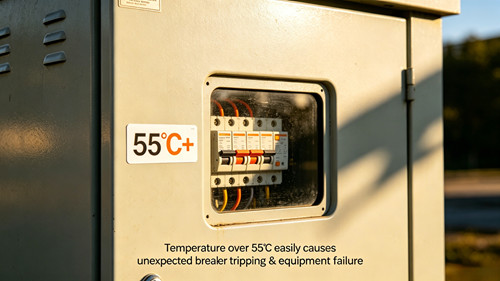
1. Temperature: The Invisible Nuisance Trip
Temperature is the most common environmental stressor, and it attacks in two forms: high ambient heat and extreme cold.
In a standard thermal‑magnetic switch, the thermal element relies on a bimetallic strip that bends with heat – both from the load current and from the surrounding air. When the enclosure temperature climbs, the strip pre‑bends, effectively lowering the current needed to trip. A device rated 20 A at 25°C might only carry 16 A at 50°C after derating. This explains why the desert telecom site trips at noon, even though the equipment draws the same current as at night. The standard IEC 60947‑2 recognises this and requires manufacturers to publish derating curves; however, many installers never check them.
Cold brings its own problems. Below about -25°C, the plastic casings of some commodity devices grow brittle, and lubricants in mechanical linkages stiffen. In extreme cases, the toggle mechanism can freeze, preventing the device from tripping when it should. A device that survives a short circuit at room temperature can shatter when operated at -40°C.
One effective countermeasure is to choose protection that doesn’t rely on thermal bimetallic elements at all. Hydraulic‑magnetic overcurrent switches operate purely on magnetic flux and a fluid‑damped plunger, making their trip point stable across a temperature range from -40°C to +85°C. This removes the derating uncertainty entirely, which is why they appear so frequently in telecom rectifier cabinets and solar combiner boxes.
2. Humidity and Condensation: The Corrosion Trigger
Moisture attacks electrical protection in two ways: it condenses on internal metal parts and promotes corrosion, or it creates a conductive path across insulating surfaces.
In coastal installations, salt‑laden humidity accelerates the process dramatically. A standard steel‑cased device with a basic gasket can show rust on the iron yoke and copper tracking on the arc chute within 18 months. Once the arc chute plates corrode, the device’s ability to extinguish an arc during a fault drops sharply – the next short circuit can weld the contacts shut.
What’s less obvious is the effect of daily temperature cycling. When a sealed enclosure warms up during the day and cools at night, the internal air pressure changes and draws moist outside air through the tiniest gaps in cable glands and door seals. Over weeks, enough moisture accumulates inside to corrode the trip mechanism.
The defence is twofold: specify an enclosure with IP65 or better, and choose a device whose internal mechanism uses stainless steel or plated copper alloys for critical current‑carrying parts. The difference in operating life between a commodity product and one built for wet environments can be five years versus twenty.
3. Altitude: The Overlooked Derating Factor
Every 1,000 meters of altitude above sea level reduces the dielectric strength of air by roughly 10%. A device rated for 2500 V dielectric withstand at sea level may only handle 1,750 V at 4,000 meters. The same applies to the arc‑quenching capability: the longer arc at high altitude takes more energy to cool and extinguish.
The practical consequence is that a protection switch with a 10 kA breaking capacity at sea level might need to be derated to 6 kA at 3,500 meters unless the manufacturer explicitly tests for high‑altitude performance. The relevant standards (IEC 60947‑2 for industrial switchgear) require altitude correction factors, but not every data sheet makes them easy to find.
If your installation sits above 2,000 meters, don’t just pick a device by its standard rating and hope for the best. Check the manufacturer’s altitude derating table. If it doesn’t exist, that’s a red flag. Some equipment protectors are specifically rated for 4,000 m and above, having been tested under reduced air pressure to verify that both dielectric strength and thermal dissipation remain adequate.
4. Vibration and Mechanical Shock
A diesel generator skid vibrates. A pump starter on a mining truck endures constant jolts. In these settings, the mechanical latching of a toggle‑operated switch can bounce open under shock, or the internal mechanism can fatigue and fail.
The standard for equipment protectors (IEC 60068‑2 for environmental testing) defines vibration test levels, but not every product is tested against them. For mobile installations or machines with reciprocating engines, look for devices that have passed sinusoidal vibration tests at 10‑55 Hz and shock tests at 50‑100 g. If the data sheet mentions “compliant with MIL‑STD‑202” or similar military shock standards, you’re in the right category.
A practical tip: in high‑vibration environments, avoid protection with delicate bell‑crank linkages and instead favour designs with a simple, robust armature and a magnetic trip. Fewer moving parts mean fewer things that can resonate or snap.
5. Dust and Chemical Vapours
Fine dust – especially conductive carbon or metallic dust from grinding operations – can settle on insulating surfaces inside an enclosure and eventually create a tracking path. When the device trips and draws an arc, that dust can flash over, sustaining the arc far longer than the design intended.
Chemical vapours from battery charging rooms, fertiliser storage, or plating shops attack nylon and ABS casings. Polycarbonate is vulnerable to ammonia and certain amines, which can cause stress‑cracking around screw bosses and hinge points. A device that looks fine on the outside can crumble when you open it a year later.
For these environments, select sealed equipment protectors with robust, chemically resistant housings. Often, a moulded case with a high‑temperature nylon 66 or PBT body, combined with an IP65‑rated front cover, provides the necessary isolation. If the atmosphere is particularly aggressive, a supplementary enclosure pressurisation system may be justified.
How to Specify a Device That Survives Its Environment
When you’re writing a specification or ordering a replacement, move beyond just the current rating and trip curve. Add these four questions to your checklist:
-
What is the full temperature range, and does the device derate predictably across it? Demand a derating curve, not a single “ambient temperature” number.
-
What humidity and salt‑spray testing has the product passed? Look for 96‑hour salt spray test reports or equivalent.
-
Is the rated breaking capacity valid at your installation altitude? If not, apply the correction factor from IEC 60664‑1 or ask the supplier for altitude‑tested data.
-
Does the internal mechanism use corrosion‑resistant materials? Stainless steel springs, copper‑tungsten contacts, and plated arc chutes make a measurable difference in coastal or tropical installations.
A Note on Hydraulic‑Magnetic Technology for Difficult Environments
In applications where temperature swings exceed 40°C over a single day, or where humidity and salt fog are constant companions, hydraulic‑magnetic protection devices have a distinct edge. Because their trip point is set by a magnetic coil and a fluid‑damped core – not a heat‑bending strip – they hold their rated current from -40°C to +85°C without derating. This eliminates the guesswork that leads to nuisance trips in July and frozen mechanisms in January.
Many telecom operators, railway signalling systems, and marine DC installations have standardised on this technology specifically because it removes environmental variability from the protection equation. If you’re managing equipment in uncontrolled climates, it’s worth exploring a range of hydraulic‑magnetic switching products tested for extreme temperature and humidity conditions.
Final Thoughts
A protection device is only as reliable as its weakest environmental tolerance. The current rating printed on the label means nothing if the ambient temperature is 20°C higher than the test lab, or if salt fog has eaten through the trip linkage. The good news is that all these factors are documented, quantified, and manageable – once you ask the right questions.
Choosing a device that fits your specific climate, altitude, and vibration profile isn’t complicated, but it does require looking past the headline numbers on the first page of the datasheet. When you do, the reward is an installation that stays online during the hottest afternoons, the dampest monsoons, and the highest mountain passes.