English
  한국어
한국어

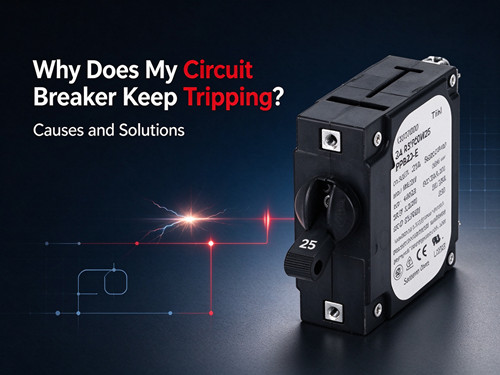
A circuit breaker that keeps tripping is one of the most common complaints in electrical systems—and one of the most frustrating. The breaker is doing its job by interrupting the circuit, but repeated trips mean something in the system needs attention. This guide walks through the most common causes of repeated tripping, how to tell them apart, and what to do about each one.
How to Tell the Difference Between Overload, Short Circuit, and Ground Fault
Before diagnosing the cause, it helps to understand what the trip pattern is telling you. Different fault types produce different trip behaviors.
| Trip Pattern | Likely Cause | What It Means |
|---|---|---|
| Trips after minutes or hours of normal operation | Overload | Current is slightly above rating for an extended period |
| Trips instantly when load turns on | Short circuit | Very high current flows immediately |
| Trips intermittently, no clear pattern | Loose connection or intermittent fault | Connection resistance changes with temperature or vibration |
| Trips immediately even with no load | Breaker internal fault or wiring error | The breaker itself may be defective |
If the breaker trips instantly with a loud "snap" and no delay, it is almost certainly responding to a short circuit or ground fault. If it trips after a delay—seconds to minutes—it is responding to overload.
Cause 1: Overload
Overload is the most common reason a breaker trips repeatedly. It occurs when the total current drawn by connected loads exceeds the breaker's rated current for a sustained period.
How to Confirm Overload
- Measure the actual current with a clamp meter while the system is running normally
- Compare the measured current to the breaker's rated current
- If the measured current is at or above 90% of the rating, the breaker is likely undersized for the load
What to Do
If the load current is genuinely higher than the breaker rating, the solution is not to install a larger breaker without checking the wiring. The wiring must also be rated for the higher current. A larger breaker on undersized wiring creates a fire hazard.
Options:
- Reduce the load (turn off non-essential equipment)
- Redistribute loads across multiple circuits
- Upgrade both the breaker and the wiring to handle the higher current
Cause 2: Short Circuit
A short circuit occurs when a live conductor touches a neutral or ground conductor, or when two live conductors touch. The resulting current can be hundreds or thousands of times the normal load current, causing an immediate trip.
How to Confirm a Short Circuit
- Disconnect all loads from the circuit
- Reset the breaker
- If it trips immediately with no load connected, there is a short in the wiring or the breaker itself
- Inspect wiring for damaged insulation, pinched cables, or loose strands touching terminals
What to Do
Locate and repair the short. Common locations include:
- Where wires enter metal enclosures (insulation chafing)
- At terminal connections (stray wire strands)
- In areas where cables are exposed to heat, vibration, or moving parts
Do not simply reset the breaker repeatedly without finding the fault. Each trip puts stress on the breaker and the wiring.
Cause 3: Inrush Current
Some loads draw a brief surge of current when first energized. Motors, transformers, capacitors, and DC power supplies with input capacitors all exhibit inrush current. If the inrush exceeds the breaker's instantaneous trip threshold, the breaker trips even though the steady-state current is well within rating.
How to Confirm Inrush Tripping
- The breaker trips immediately when the load is switched on, but holds when the load is already running
- The trip happens consistently at startup, not randomly
- A clamp meter with peak-hold function shows a current spike far above the steady-state value
What to Do
- Select a breaker with a trip curve designed for motor loads or high-inrush applications
- For DC systems with capacitive loads, use a pre-charge circuit to limit inrush current
- In some cases, a breaker with a higher instantaneous trip threshold (but the same continuous rating) solves the problem
Cause 4: Loose Connections
A loose terminal connection creates resistance. Under load, that resistance generates heat, which causes expansion and contraction as the system cycles on and off. Over time, the connection can degrade further, causing intermittent trips.
How to Confirm
- The breaker feels warm or hot to the touch
- Terminal screws are loose when checked
- Discoloration or heat damage is visible at terminals
- Trips occur more often after the system has been running for a while
What to Do
- De-energize the circuit
- Tighten all terminal connections to the manufacturer's specified torque
- Inspect for signs of heat damage; replace any damaged wiring or terminals
- Use a calibrated torque wrench—over-tightening can also damage terminals
Cause 5: Breaker Sizing or Type Mismatch
Not all breakers are interchangeable. A breaker selected for the wrong application may trip unnecessarily.
Common Sizing Errors
| Error | Consequence |
|---|---|
| Breaker rated too close to load current | Nuisance tripping during normal fluctuations |
| AC-rated breaker used on DC circuit | Failure to interrupt arc, possible contact welding |
| Wrong trip curve for the load type | Trips on inrush, or fails to trip on overload |
| Breaker installed in a high-temperature enclosure | Derating not accounted for, premature trip |
What to Do
Review the original selection criteria. Confirm:
- The breaker is DC-rated (if used in a DC circuit)
- The continuous current rating has adequate margin above the load
- The trip curve matches the load characteristics
- The ambient temperature inside the enclosure is within the breaker's rating conditions
Cause 6: Breaker Internal Failure
Breakers can fail internally. Contacts may wear out, mechanisms may become stiff, or moisture may enter the housing. A breaker that trips with no load connected and no wiring fault is likely defective.
How to Confirm
- Disconnect the breaker from the circuit
- Measure resistance across the terminals in the ON position
- A healthy breaker should show near-zero resistance
- If resistance is high or unstable, replace the breaker
Troubleshooting Flowchart
Use this sequence to narrow down the cause:
- Does the breaker trip immediately with no load?
Yes → Check for short circuit or defective breaker
No → Continue - Does the breaker trip immediately when load is switched on?
Yes → Suspect inrush current or short circuit in the load
No → Continue - Does the breaker trip after a delay (seconds to minutes)?
Yes → Measure load current; suspect overload or loose connection
No → Continue - Does the breaker trip randomly?
Yes → Inspect for loose connections, vibration, or intermittent faults
When to Call a Professional
If you have checked the load current, inspected for shorts, tightened connections, and confirmed the breaker is correctly rated, but it still trips, the issue may require a professional electrical evaluation. Do not continue resetting a breaker that trips repeatedly—this can damage the breaker and create a safety hazard.
FAQ
Why does my breaker trip only when I turn on a specific device?
This usually points to inrush current or a fault within that device. Motors and capacitive loads draw a surge at startup. If the breaker trips only for one device, check that device's wiring and consider whether a breaker with a different trip curve is needed.
Can I just replace the breaker with a larger one?
No. The breaker protects the wiring. Installing a larger breaker without upgrading the wiring can cause the wiring to overheat and create a fire hazard. The breaker, wiring, and load must all be properly coordinated.
Why does my breaker trip at night or when it rains?
Moisture ingress can create ground faults or reduce insulation resistance. If tripping correlates with weather, inspect outdoor enclosures, conduit seals, and cable insulation for water entry.
How do I know if my breaker is defective?
Disconnect the breaker from the circuit and measure resistance across the terminals in the ON position. If it does not show near-zero resistance, or if it trips with no load connected and no wiring fault, it is likely defective and should be replaced.
What is the difference between overload and short circuit tripping?
Overload tripping occurs after a delay—the breaker allows a small overcurrent to flow for a period before tripping. Short circuit tripping is immediate—the breaker responds to a very high current with no intentional delay.
Can a loose wire cause a breaker to trip?
Yes. A loose connection creates resistance, which generates heat. The heat can cause the connection to degrade further, leading to intermittent current paths or arcing. Loose connections are a common cause of nuisance tripping.
Conclusion
A breaker that keeps tripping is telling you something. The trip pattern—immediate versus delayed, consistent versus random—narrows down the cause. Start by measuring the actual load current, then inspect connections, check for short circuits, and verify the breaker is correctly sized and rated for the application.
If the cause is not obvious after these checks, do not keep resetting the breaker. Consult a qualified electrical professional. To review circuit breaker specifications and selection criteria, visit the circuit breaker product line. For technical questions about breaker selection or application, contact our technical team.